
Highlights:
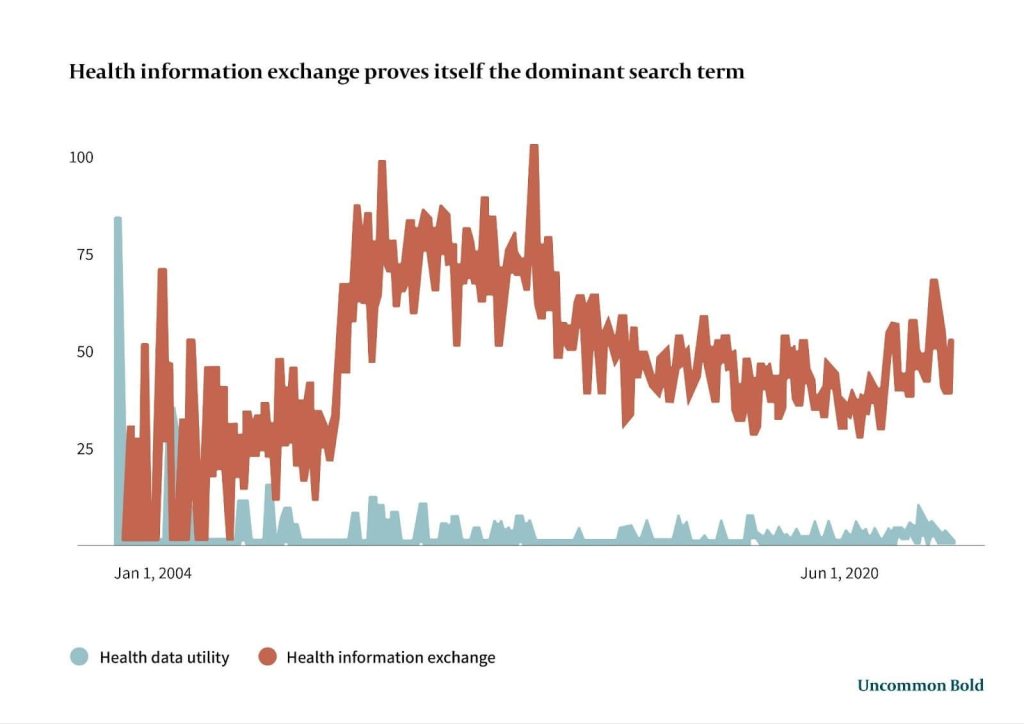
- Health information exchange outperforms health data utility for search interest, holding a near 15-year lead
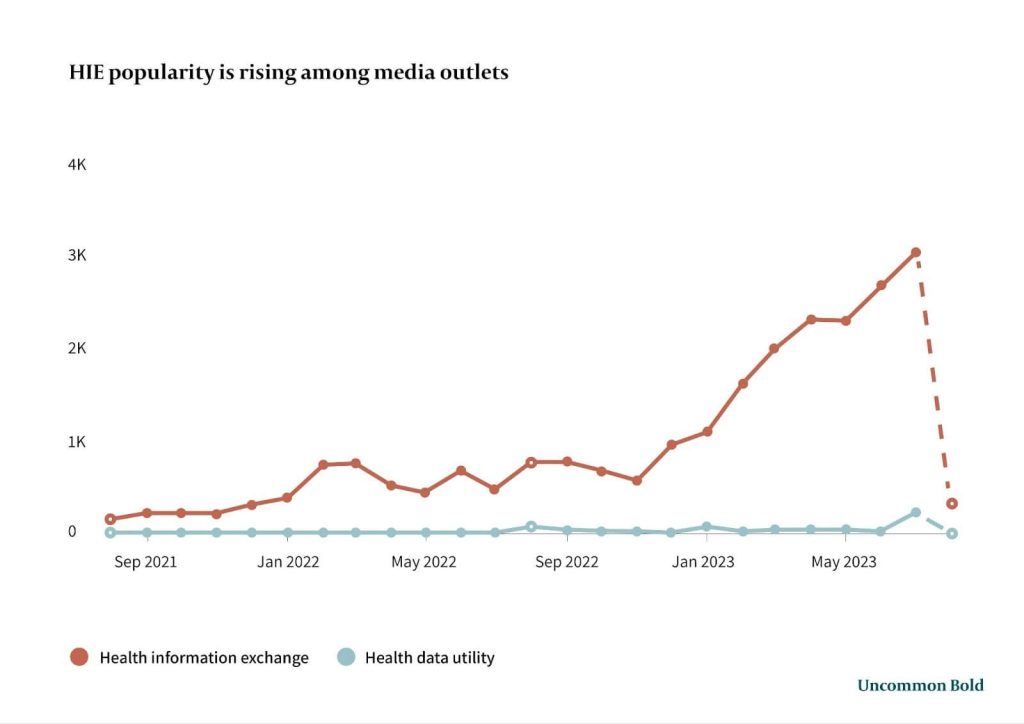
- Over the past year, HIE use has skyrocketed among media while HDU remains stagnant
It is the challenge with a dozen names: interoperability, data blocking, regional health information offices (RHIOs), health information network (HIN), health information exchange (HIE), health data networks (HDN). Over the past 15 years, there have been many different ways to describe health data sharing — or the lack thereof. No matter what you call it, building systems that share accurate, timely health information is one of most important and impactful areas of healthcare technology progress today.
What should we call it? HIE has been the general term for a while now, and there’s been a recent push to move toward an updated model of health data utility (HDU). Preferred by organizations including Civitas Networks for Health and VITL, both collaborators with Uncommon Bold, HDUs reference broader systems that integrate aggregation and a deep analysis of health data to drive actionable insights.
Even though our team sometimes hears the two terms used interchangeably, we’re not surprised that health information exchange still outperforms health data utility by a healthy margin. Looking back nearly 20 years, the use of health data utility was a bit more frequent than today, but not by much. The term’s most popular moment in early 2004 garnered less than half the search volume of health information exchange’s highest point in 2013. Health information exchange hit its first peak in 2005, setting off on a rapid upward trajectory in the years to follow. During this period, the entire healthcare landscape was experiencing the big boom in technology, and improved care coordination became top of mind for healthcare providers (this coincides with the rise in EHR use, but we’ll get to that in another post).
As you can see in this first Google Trends graph, the heyday of HIE interest was between 2009 and 2013 — which coincides with the large policy focus on health technology infrastructure sparked by the 2009 stimulus plan. The HIE keyword started to boom again in January 2022, likely related to TEFCA and AB 133 conversations.
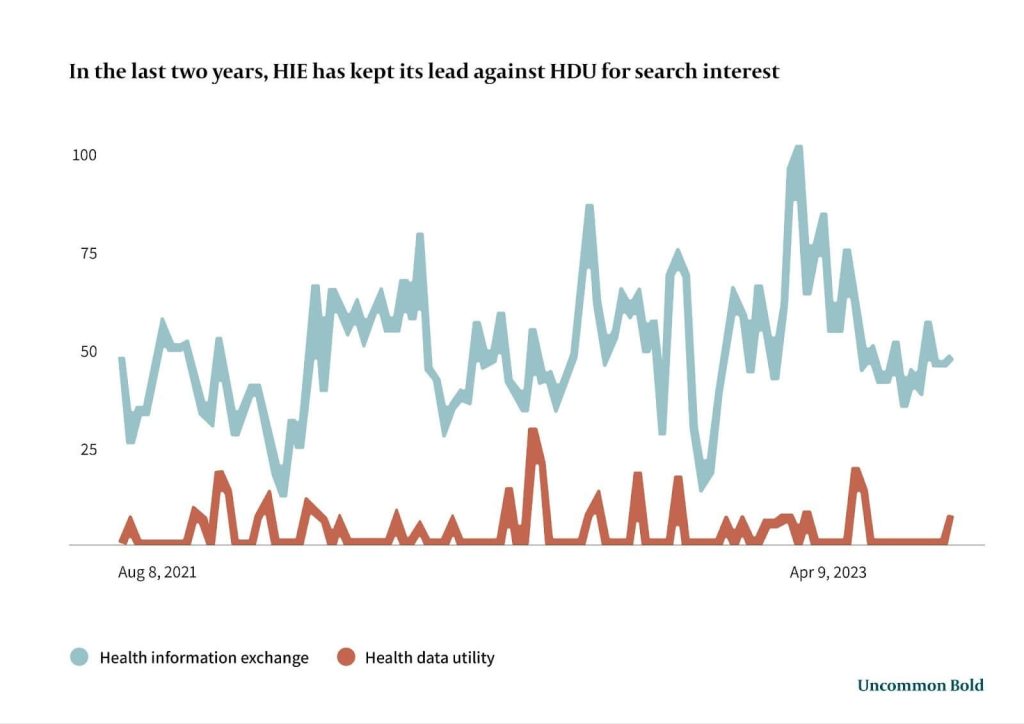
Looking at just the past two years, we see health information exchange continuing to generate more interest than health data utility — with a seasonal dip around December each year. When analyzing regional searches of health information exchange, the top five locations are home to some serious HIE powerhouses: Indiana (IHIE), Maryland (CRISP), Arizona (Contexture), Kentucky (KHIE), and Oklahoma (in the process of establishing their HIE).
In the media landscape, more reporters are covering health information exchange than ever before, and we do see a hopeful spike for health data utility on the rise recently.
While health information exchange continues as the most common term, our team is cheering on health data utility in the future. To us, the “utility” model more accurately reflects the extensive work of regulatory compliance, data refinement, aggregation, and delivery that HIEs maintain as independent resources for their communities.
What do you think? Will HIE continue to reign supreme? Is there another new term you’re seeing on the horizon?