
Wearable Tech is a Sign of the Times — And the Future
Highlights:
- Smartwatch usage has increased 41% over the past two years, from 323.99 million to 454.69 million users, signifying its increased adoption worldwide.
- Apple Watch remains in the lead in the wearable technology industry, but other companies are developing their own products to compete in this relatively young market.
Time to stand! Stand up and move a little for one minute. If you own an Apple Watch, you may recognize this friendly reminder that buzzes on your wrist every hour. Wearable technology has made strides over the years, transitioning from niche devices that health junkies would utilize to track their metrics to mainstream health-monitoring tools for the everyday individual. Wearables, such as headphones, fitness trackers, and smartwatches, are smart, sensor-equipped devices that can be worn and connected to the internet to collect, transmit, or analyze data. With the introduction of AI and other technological advances, it’s hard to know exactly what’s next for this industry.
The market for wearable technology continues to grow steadily. It was estimated at $84.2 billion in 2024 and is expected to have a compound annual growth rate of 13.6% from 2025 to 2030 — reaching a revenue of $186 billion. Wrist-wear was the most profitable product segment, registering the fastest growth during the forecast period and accounting for $50.6 billion of the 2024 market.
As of this year, 454.69 million people around the world own a smartwatch, a staggering 41% increase from 2023. We’ve come a long way from the first real multi-role wristwatch, Hewlett Packard’s HP-01, developed in 1977. The Wrist Communicator T-37 was introduced on the TV show “Get Smart” just a few years earlier! HP-01 was a combination of a calculator and a wristwatch, but it also allowed users to set timers and change time zones. The success of the HP-01 paved the way for future innovations and the eventual first wireless smartwatch, Microsoft SPOT (Smart Personal Object Technology), which was launched in 2004.
2007 marked a shift for the world of wearable health monitors with the launch of the Fitbit. It was originally introduced as a device that could be clipped onto clothing or worn as a wristband, tracking a user’s steps, distance, and calories burned. Incremental updates included a website that allowed users to monitor their progress, a digital clock, sleep tracking capabilities, Bluetooth connectivity, built-in GPS, and more. Fitbit dominated the industry in 2014, owning 67% of the activity-tracking market and selling 21.4 million devices in 2015. Many companies also provided it as an employee benefit. However, as the smartwatch industry took off, devices like the Apple Watch began to expand the sector’s popularity.
Apple found a way to break through and make its imprint in the health-tracking market. Their strong reputation for innovation and reliability set them apart from their competitors and allowed them to revolutionize the industry. Initially released in 2015, Apple’s smartwatch began to gain traction when its focus shifted to its health and fitness capabilities. In 2018 they released FDA-cleared EKGs that could detect atrial fibrillation. It could determine when you took a hard fall and call for help, and it would even alert you if your heart rate spiked abnormally. It was saving lives and proving that technology could play such a critical role in our everyday health experiences. Although Apple states on its website that the Blood Oxygen App is intended for general wellness monitoring, a doctor used an Apple Watch to detect a patient’s low oxygen saturation and provide necessary treatment during a medical emergency on a flight.
More discreet health-monitoring devices have generated buzz in the public, like the Oura Ring, which was launched in 2015. Since its launch, several studies have been conducted on its effectiveness, leading to its increase in media coverage and public popularity. The sleek and sleep-focused measuring device also provides insights into women’s health and mental health and conducts advanced health tracking.
In 2024 Oura secured a $96 million contract with the Pentagon to supply their ring to U.S. military personnel and also partnered with Dexcom to integrate glucose monitoring metrics into the ring. Both events likely contributed to their peak in media coverage and public interest.
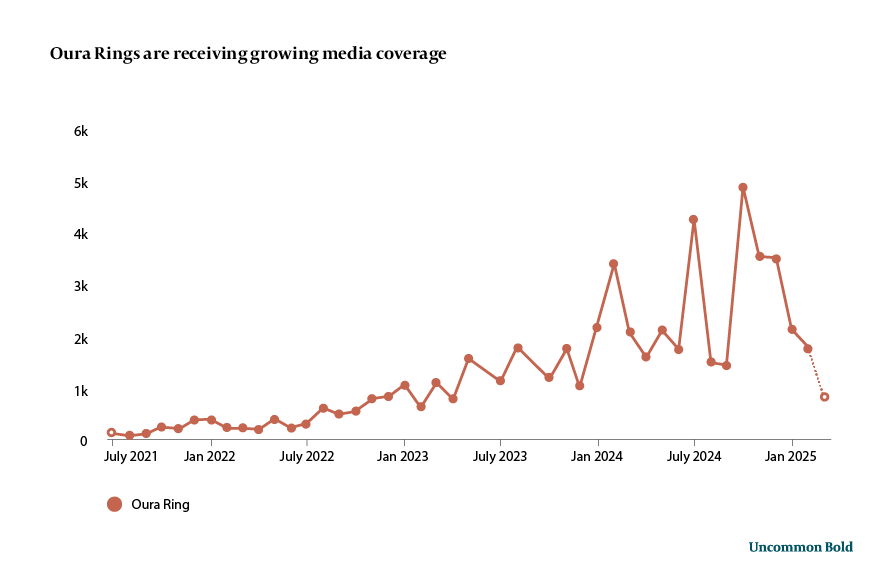
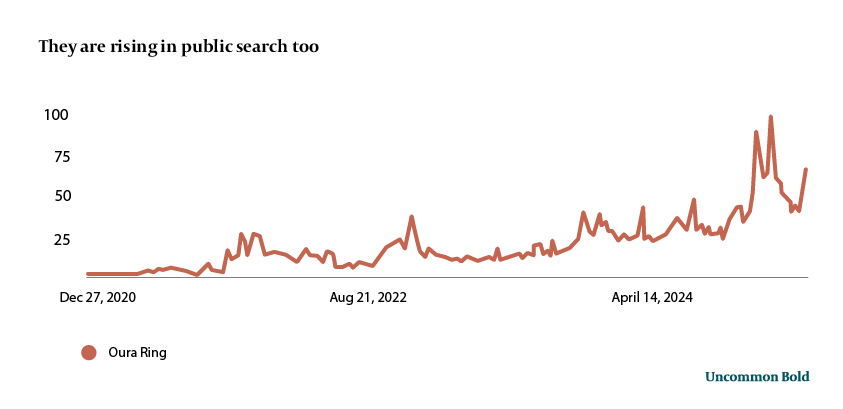
One user posted on LinkedIn that her Oura Ring notified her that she was sick, and a few hours later she tested positive for COVID-19. Doctors are recognizing the possibilities of patient care with wearable technology, but the devices’ roles in routine care remains a topic of discussion needing further research. Although new health and wellness gadgets like the Oura Ring are making a statement in the market, they remain far behind the Apple Watch in terms of publicity and public search. The large spike in media coverage for “Apple Watch” in 2023 is likely due to the double tap gesture that was introduced in Series 9, allowing users to control their watch by simply raising their wrist and tapping their thumb and pointer together twice, activating the primary function button.
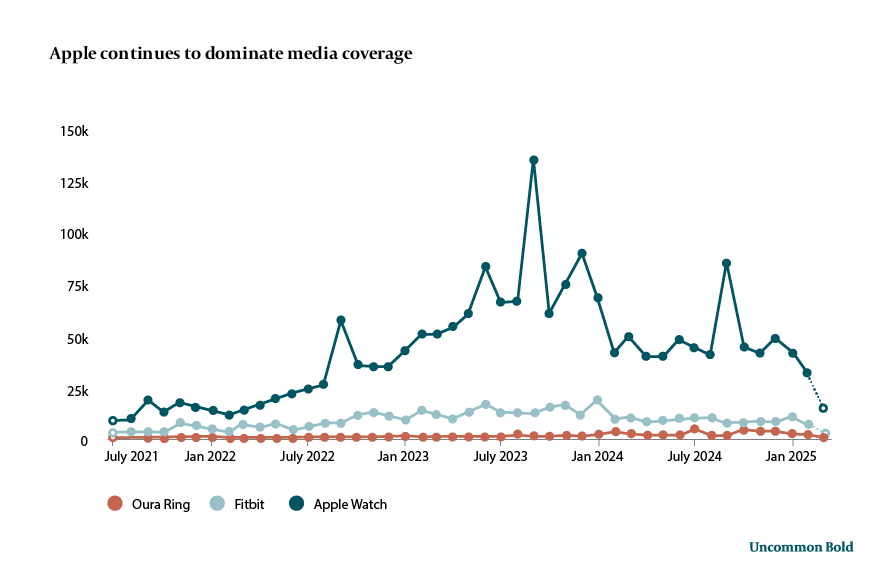
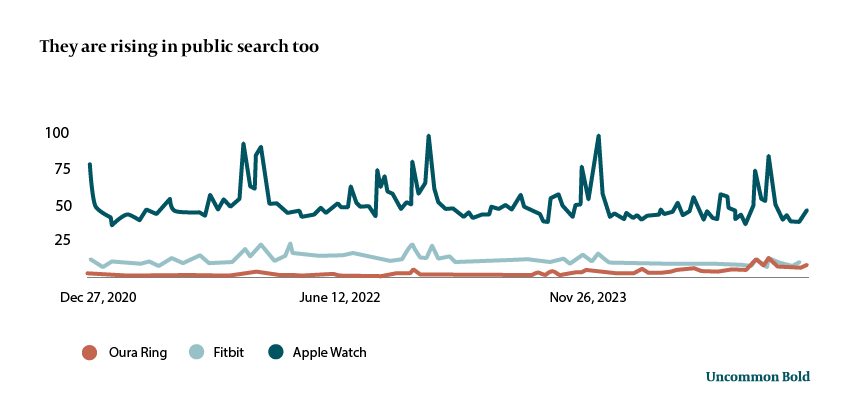
Artificial intelligence has allowed these companies to rapidly enhance the capabilities of their health-monitoring devices. Fitbit, Oura Ring, and Apple Watch incorporate AI algorithms into their devices that analyze users’ health metrics to provide personalized health recommendations and alerts. For individuals living with illnesses or medical conditions, this is revolutionary in helping them monitor their health metrics and well-being on their own. These advancements can only hint at what the future will look like in the next 10 years for smartwatches. Will patients eventually look to their wearable devices for medical advice instead of visiting a clinic? It’s hard to say.
Many companies have recognized consumers’ desire to take control of their own health and have released their own versions of smartwatches and fitness tracking devices. However, this has created an oversaturated market, making it challenging for startups to compete with industry giants like Apple and Samsung. And according to angel investor Deep Bajaj, a cultural shift has created more price-sensitive consumers.
Doctors and healthcare professionals recognize the many benefits of wearable tech like preventive care and chronic disease management and recommend them to their patients. However, these devices are best used in conjunction with a professional and are never a replacement for one. We’re eager to see how AI is further incorporated into these devices and how future research will influence its role in patient care. Whatever happens, it’s clear: Wearable technology is here to stay.
Do you own a smartwatch, Oura Ring, or any similar fitness-tracking device?