
Redefining Women’s Health Beyond “Bikini Medicine”
Highlights:
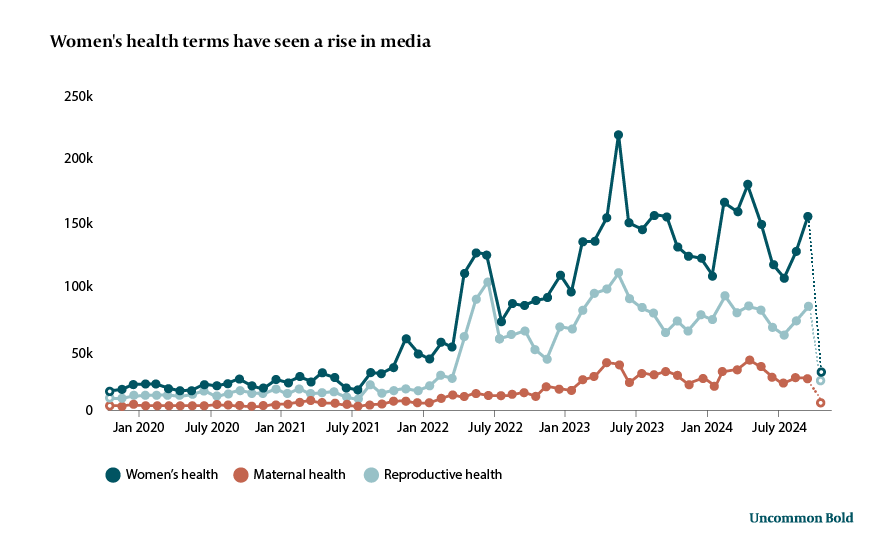
- Women’s health, maternal health, and reproductive health all have slightly different meanings and are gaining substantial momentum in the media; elements of these terms have also seen major increases within published books
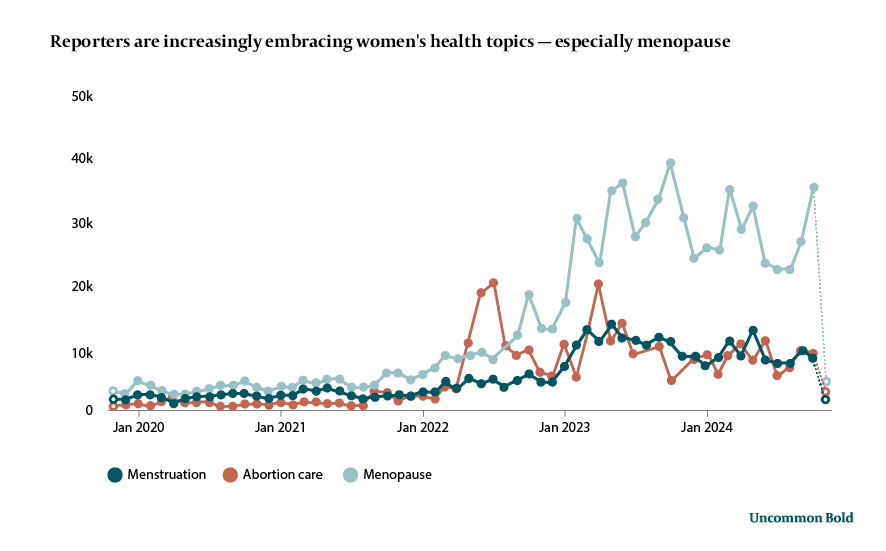
- The increased use of more clinical, direct women’s health terms, like abortion care, menopause, and menstruation in media, reflects a cultural shift toward addressing a wider range of women’s health needs
Historically, women’s health has been narrowly defined. In fact, it was once dismissively referred to as “bikini medicine,” a term coined in the 20th century to describe healthcare that focused primarily on body parts covered by a bikini. This reductive view neglected systemic issues and broader factors impacting women’s health. Today, we’re seeing a shift toward a more comprehensive and inclusive approach in healthcare language.
Much of this progress is thanks to the Women’s Health Movement (WHM), which began during the 1960s and the 1970s as part of the broader feminist and civil rights movements with the aim of advancing healthcare for all women. This time period marked the beginning of the second wave of feminism, a movement that extended through the 1980s and was instrumental in shaping modern gender equality. New terms and distinctions have emerged since then, clarifying more specific focus areas within women’s healthcare that extend beyond reproductive capabilities. But some of these terms, such as women’s health, maternal health, and reproductive health, are used in overlapping contexts, leaving many to wonder: What’s the difference?
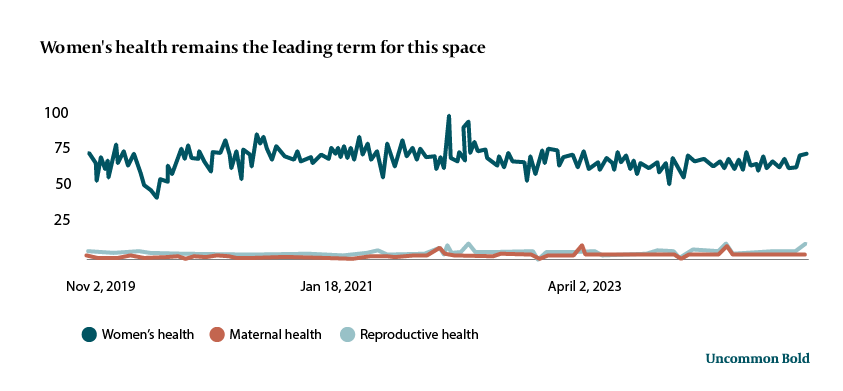
Women’s health is the broadest category, encompassing health issues that are “unique to women, such as menstruation and pregnancy, as well as conditions that affect both men and women, but that may affect women differently, such as heart disease and diabetes.” This category acts as a catch-all, which explains why it’s the most widely used term across both Google’s search engine and in the media.
According to the World Health Organization, maternal health, with Old French roots from the 14th-century term “maternel,” is defined as the “health of women during pregnancy, childbirth and the postnatal period.” While this term is more focused on healthcare surrounding the childbearing process, reproductive health is less specific, as it refers to the condition of both male and female reproductive systems during all life stages. For females specifically, this includes topics such as menstruation, fertility, abortion, and menopause.
While search engine traffic has maintained a steady trendline for all three terms, media reporting trends have shown significant increases, especially during the past three years. This surge can likely be attributed to several factors, including major shifts in reproductive rights and health policies, such as the Supreme Court decision to overturn Roe v. Wade in June 2022. This decision brought heightened attention to issues surrounding reproductive health, impacting the amount of reporting on women’s access to care, safety, and autonomy.
Literature has similarly reflected the significant rise in more inclusive terminology, including even foundational terms, such as “women” and “woman.” Maternal and reproductive saw large spikes around the same time, beginning in the 1960s — a pivotal time for women’s rights in the United States and around the world. Women’s health today has greatly benefited from the changes in policy and education that were implemented during that time.
Use of “women” in published books:

Use of “woman” in published books:

Use of “maternal” in published books:

Use of “reproductive” in published books:

As terminology in this sector shifts, it’s important to recognize that commonly used terms within this space often exclude individuals with female reproductive organs who don’t identify as women along with those who don’t have female sex organs but identify as women. In 2021, the digital health venture fund Rock Health introduced the term “women+ health” to address this gap. Although the term hasn’t been widely adopted across media or within healthcare settings, it offers an inclusive framework that should be considered for addressing the full range of health needs experienced by cisgender women, transgender individuals, nonbinary people, and others whose health concerns align with those of cisgender women.
Women’s health terms are continuing to evolve, becoming more widely accepted and integrated into mainstream media conversations along the way — both within and beyond healthcare settings. Topics and terms once stigmatized and considered to be taboo are now gaining visibility in both policy and public discourse. For example, reporting trends for menstruation, abortion care, and menopause have been on the rise for the past few years. Menopause has seen the largest spike in usage, especially throughout 2023.
The rise of “FemTech”, a term proposed by Ida Tin in 2016, has also led to an increase in technological innovations that help healthcare gaps for women, such as period trackers and fertility monitors. The sector is projected to reach over 117 billion U.S. dollars worldwide by 2029, highlighting the need for dedicated innovations that support women’s unique health needs. As these solutions continue to be developed, we expect to see conversations around women’s health grow even more.
The expansion and wider use of women’s health terminology mark progress toward a healthcare system that recognizes the complex needs of women, moving beyond “bikini medicine” to a healthcare structure where women’s health is not an afterthought but a priority.
What do you think? Are there other areas of women’s health that need more attention?