
What’s the Best Way to Refer to Medical Professionals?
Highlights:
- Doctor leads across search interest and book mentions, but provider dominates for media use (when not using “healthcare” or “medical” as a clarifier for either term)
- Provider is being challenged in the media as an inadequate description of physicians
The terms we use to refer to medical professionals — physician, provider, clinician, and doctor — have shifted as our understanding of these roles has expanded throughout history and in modern-day healthcare. These terms, while often used synonymously, carry different meanings and implications for the roles they describe. So which terms are best to use? Well, it depends on who you ask.
Over the past decade, provider is the one term that has seen the largest increase in usage. Medicare began using the term in 1965 to refer to entities that qualified to receive Medicare payment, but it didn’t gain traction until the 1980s and 1990s when it was more widely adopted by government and insurance sectors, becoming more central to managed care systems. The term encompasses a broad range of healthcare professionals, including physicians, nurse practitioners, and physician assistants, aligning with the shift toward team-based care models.

While provider is still popular in use among medical settings, some healthcare leaders are beginning to dial down their use of the term. In fact, the American Medical Association (AMA) has even adopted a policy that calls for ensuring that “all references to physicians by government, payers, and other health care entities involving contracts, advertising, agreements, published descriptions, and other communications at all times distinguish between physician … and nonphysicians, and to discontinue the use of the term ‘provider.’”
Additionally, some medical professionals, especially physicians, may feel that the term provider diminishes the vast amounts of training they have undergone and their level of expertise. As a 2019 Forbes article put it, “The value of the doctor is the person and not simply what he or she can ‘provide.’” An NIH journal article also points out the term’s dark origins, specifically its association with Nazi-era devaluation of Jewish physicians.
The term clinician has also grown in usage, although not by much relative to the other terms, particularly within academic and professional settings where it is used to describe the practical, patient-facing aspect of healthcare roles. Originating from the French word “clinicien” in the 1800s, the term broadly refers to anyone who provides direct patient care, which can include physicians, nurses, therapists, and other healthcare workers. At Uncommon Bold, our general style guide is to use this term, which seems to be the term that is clearest and generally accepted.

Unlike provider and clinician, the term physician has been in use since the 13th century and is the longest-standing term among the mentioned alternatives. This term emphasizes the medical training and expertise of doctors, specifically those who specialize in practicing general medicine and not surgery. Although the term has a long history within medical practice, its relative popularity has seen a decline over the years across search interest, media, and inclusion in books.


The word doctor is more than 2,000 years old, derived from the Latin word for “teacher.” Similar to physician, the term has deep linguistic roots and has maintained its popularity across centuries. While “doctor” remains the most searched term amongst its alternatives, its ambiguity means it is less precise in the context of healthcare. In a Psychiatric Times piece, Dr. Ronald Pies writes about how “More and more non-physicians who possess a doctorate degree are using the word ‘doctor,’ which the public understands to be a doctor of medicine. While many possessing doctorate degrees may legitimately refer to themselves as doctors, only doctors of medicine can legitimately refer to themselves as physicians.” He suggests using the term physician as a way to distinguish doctors of medicine without reducing them to being a provider.
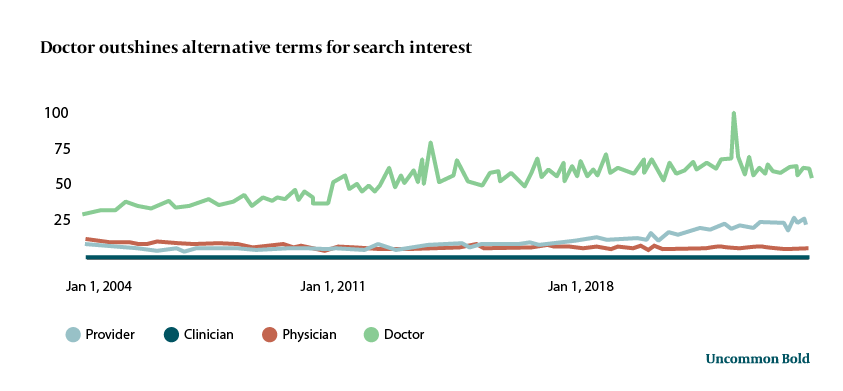

However, when adding “medical” as a clarifier before doctor, the term “medical doctor” comes in last place for search interest. This is unsurprising considering its length compared to viable alternatives — both journalists and search engine users likely prefer to use more concise language.
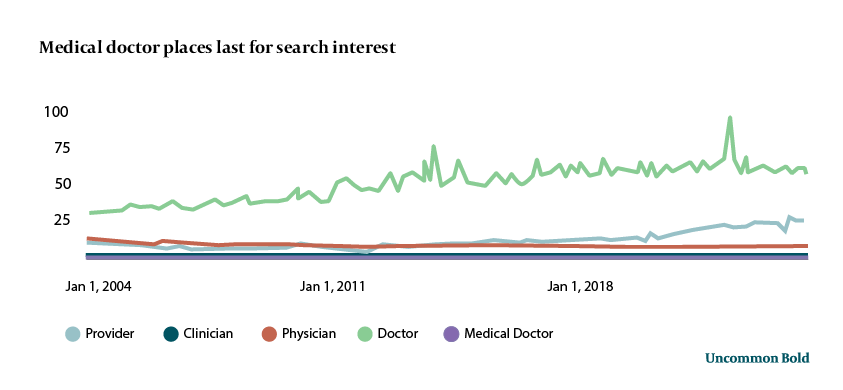
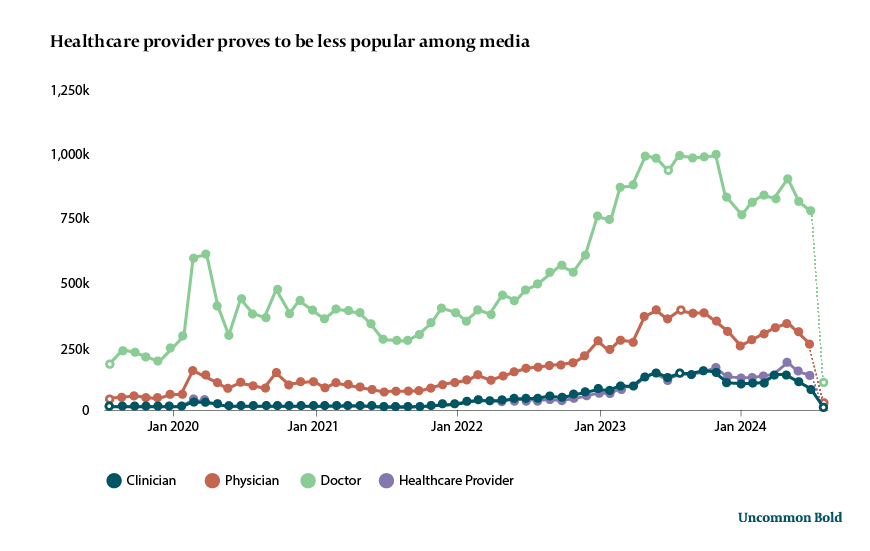
Similar results stem from other terms with an added clarifier, such as “medical provider” or “healthcare provider,” supporting the possibility that term length may play a part in how widely adopted these terms are.

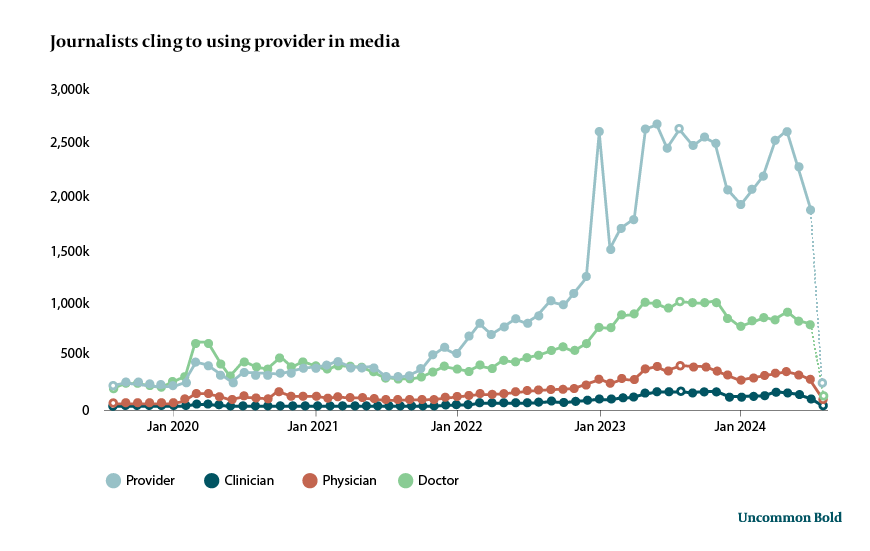
Although provider and doctor used to be neck-in-neck in terms of media use just a few years ago, there has been a soaring increase in media coverage using the term provider, well surpassing the usage of doctor among journalists. This pattern change in media usage began toward the end of 2021, aligning with the increased use in the variation “healthcare provider.” When adding the clarifier, the term showed less coverage, but a similar long tail upward trend. However, the clarifier also allowed physician to surpass the term, reflecting the same results as the search interest when comparing against the “healthcare provider” variation.
From the rise of team-based healthcare to the growing number of medical professionals advocating for preferred naming conventions that accurately embody their professional identity, the language we use to describe roles in healthcare will undoubtedly reflect these changes.
Are you surprised at how provider has taken the healthcare landscape by storm? Do you agree physician should replace provider as the standard within medical communications?