
Highlights:
- Telehealth leads across search interest and media, signaling a unified consensus on its usability
- Telemedicine is next in line, trailing closely behind telehealth for both media and Google Trends, while newer entrant virtual care lags behind
Telehealth, telemedicine, and virtual care were already hot topics over the past decades and then boomed stratospherically when the COVID-19 pandemic both necessitated and increasingly reimbursed for this type of care. Things have cooled off slightly, but telehealth remains an important area of conversation for digital health as a solution for expanding patient access. What’s the best way to talk about these trends?
While often used interchangeably, telehealth, telemedicine, and virtual care each have distinct definitions. Telehealth encompasses all healthcare services provided remotely and focuses on real-time interactions between patients and healthcare providers. Although telemedicine has more than one hundred different peer-reviewed definitions, it is usually used to specifically describe clinical services provided remotely, such as virtual consultations, diagnosis, and remote monitoring. Virtual care is the broadest of these terms, and like telehealth, it not only integrates both clinical and non-clinical care services such as e-prescribing, educational resources, and health administration, but it also includes a wider range of technologies, including two-way messaging platforms, asynchronous care, mobile apps, and AI chat bots.
The concept of telehealth dates back several decades, but it didn’t begin gaining significant traction until the early 2000s. The development of high-speed internet and mobile technology underscored the potential for technology to bridge the gap between patients and providers, allowing the concept to become more mainstream. The COVID-19 pandemic acted as the true catalyst for the telehealth boom, however, leading to an astronomical increase in the use of telehealth as a tool for maintaining access to healthcare among social distancing measures and lockdowns. In fact, at the start of the pandemic, telehealth visits increased from about 5 million to more than 53 million among Medicare recipients alone.
During this boom, the transition from phone visits to video care also sped up significantly. Although one study revealed that before COVID-19, only 14% of Americans had ever done a telehealth visit, its use skyrocketed well beyond phone calls as a form of care communication. While phone call visits increased significantly during the pandemic, with the largest increase in phone calls to primary care practices coming from patients in the 40- to 69- year-old demographic — likely due to an aversion to adopting new technology — telephone visits have not sustained their popularity post-COVID. Many practices quickly adopted video visits to ensure they would receive reimbursement, especially after CMS signaled it might stop reimbursing for telephone visits once the public health emergency ended.
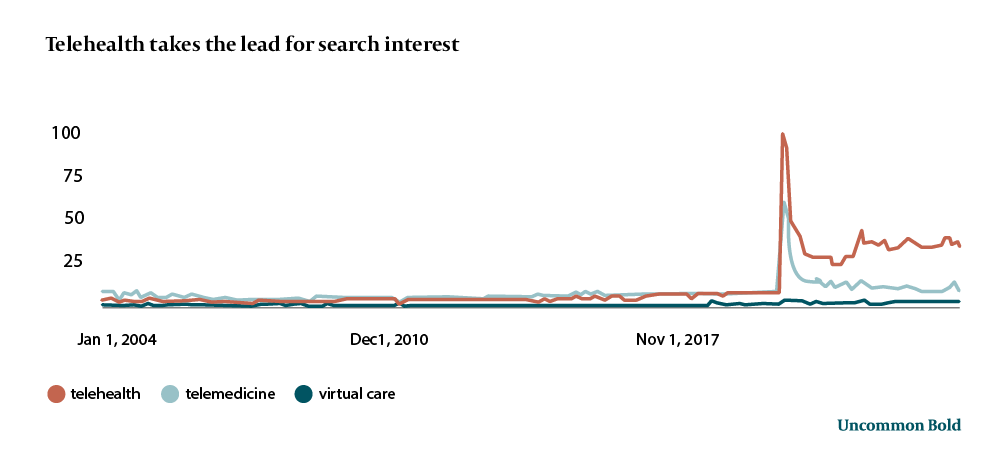
While telehealth has gained a strong foothold, telemedicine is not far behind. The term telemedicine was first coined in the 1970s by American publisher Thomas Bird, with the literal translation being “healing at a distance” (from Latin “medicus” and Greek “tele”). Telemedicine often leads the conversation when discussing the future of clinical care due to its precision in addressing the clinical aspects of remote care. However, in the broader context of healthcare innovation and among the public, telehealth appears to have the upper hand. Its inclusivity makes it adaptable to a range of services beyond clinical care, encompassing educational and administrative functions crucial for a comprehensive healthcare system. Google search interest for the terms reflects this as telehealth maintains a lead of more than double the number of inquiries telemedicine receives.
Similar to the other two terms, virtual care has emerged as a critical component of the healthcare sector post-pandemic. As technology evolves, virtual care platforms are becoming more complex, offering features such as AI-driven components and integrated health monitoring. Although all three terms experienced a spike in search interest in March 2020 due to COVID, virtual care saw the smallest increase, almost negligible on the graph with all three terms. Close up, the peak is more prominent, and while the post-COVID trendline is higher than pre-COVID levels, telehealth has maintained its inflation in interest significantly more than both telemedicine and virtual care.

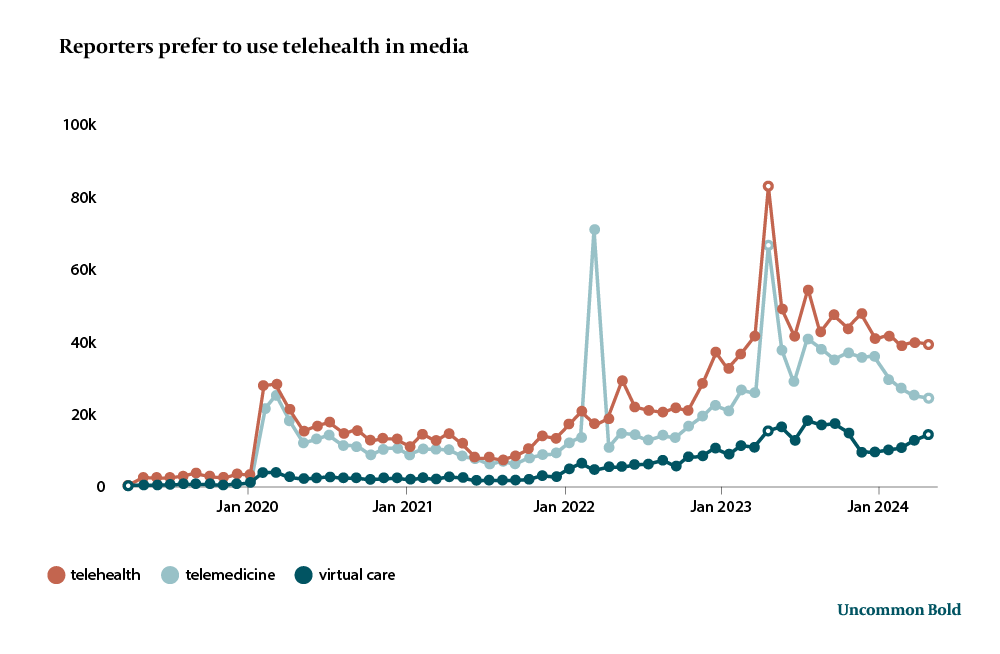
While lagging behind for search interest, virtual care performs at a more competitive level in the media, though not by much. Analyzing coverage from the past five years for these terms, telehealth has had the largest share of voice at 49%. Telemedicine comes next at 38.4% and then virtual care at 12.6%. The largest peaks for telemedicine have been in April 2020 and May 2023. Telehealth also hit a peak during May of last year, while the highest point for virtual care was in August of 2023. This uptick in trendlines is evidence that the conversations around remote care are more relevant than ever.
While telehealth currently leads in both search interest and application, the future may see more balanced usage of all three terms. The rise of generative AI and continued advancements in mobile technology will likely drive further innovation in virtual care, potentially redefining patient-provider interactions once again.
As we move forward, it will be fascinating to see which term ultimately dominates the conversation. With ongoing innovations and a growing emphasis on accessibility, the future of healthcare is undoubtedly digital. Whether it’s telehealth, telemedicine, or virtual care, one thing is clear: These technology channels for patient care are here to stay.